
LTV Guide: Understanding Your Housing Loan and Down Payment
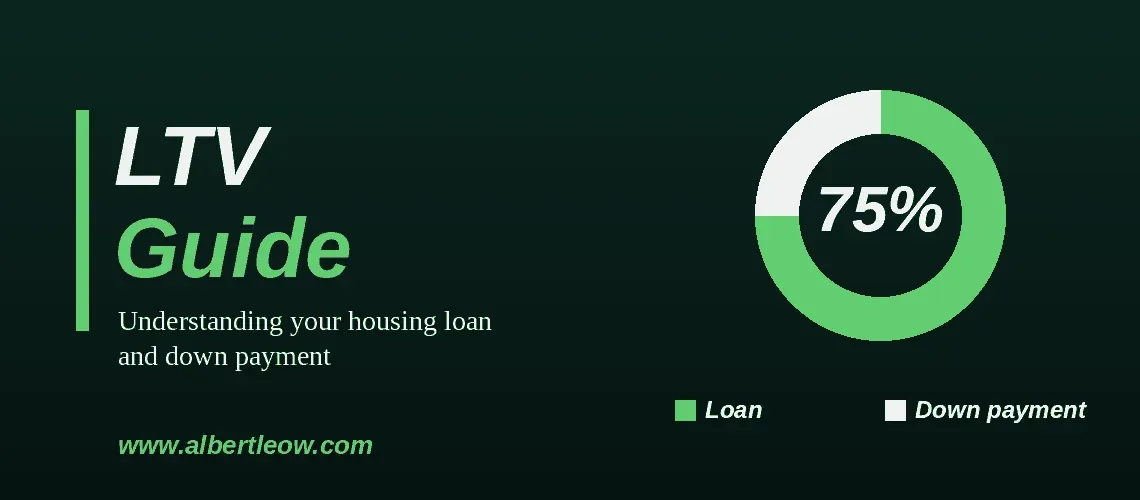
How much of your property purchase can you finance—and how much must you prepare yourself?
When we plan your purchase budget with you, we start with the Loan-to-Value (LTV) limit. This determines the maximum proportion of the property’s assessed value that your housing loan can cover.
In this guide, we explain the main LTV rules, illustrate the down-payment calculations and highlight situations that may increase your cash requirements.
This guide focuses on residential property purchases by individuals in Singapore.
1. What Is Loan-to-Value?
LTV expresses your housing loan as a percentage of the property value used for financing.
For a typical purchase, financing is based on the lower of the purchase price or valuation, subject to applicable adjustments and lending rules.
LTV = Housing loan ÷ Property value used for financing × 100%
For example, if the purchase price and valuation are both S$1,000,000, a 75% LTV limit gives a maximum loan of S$750,000 under that limit.
You would need to fund the remaining S$250,000 through cash and permitted CPF savings. Stamp duties and other purchase expenses are additional.
Our analysis: We treat LTV as a financing ceiling. Your approved loan may be lower after the lender assesses your repayment capacity and circumstances.
2. Bank Loan LTV Limits
For individuals, bank housing loan limits depend on the number of outstanding housing loans and the applicable age and tenure conditions.
| Outstanding housing loans | Standard maximum LTV | Reduced maximum LTV | Minimum cash down payment |
|---|---|---|---|
| None | 75% | 55% | 5% under the 75% limit; 10% under the 55% limit |
| One | 45% | 25% | 25% |
| Two or more | 35% | 15% | 25% |
The reduced limit applies if either:
The loan tenure exceeds 30 years, or 25 years for an HDB flat; or
The loan extends beyond the borrower’s 65th birthday.
For joint borrowers, the bank uses an income-weighted average age for this assessment.
These percentages refer to the applicable property value used for financing. Any purchase price above valuation requires separate funding.
Our analysis: We check your outstanding housing loans rather than simply asking whether this is your first or second property. Property ownership and outstanding loan count are different measures.
3. HDB Housing Loans: A Separate Assessment
An HDB housing loan can cover up to 75%, subject to eligibility and HDB’s assessment. For a resale flat, this is based on the lower of the purchase price or valuation.
The remaining lease also matters. If it does not cover the youngest applicant to age 95, the maximum loan limit is reduced proportionately under HDB’s rules.
Unlike a bank loan, an HDB housing loan does not impose the same minimum cash down-payment requirement. You may use eligible CPF Ordinary Account savings towards the down payment, subject to CPF and HDB rules. Cash is still needed for amounts that CPF and the approved loan cannot cover.
Our analysis: We would confirm your HDB Flat Eligibility letter outcome and usable CPF savings before deciding that a particular flat fits your budget. The maximum 75% limit is not an automatic entitlement.
4. Example: Your Down Payment with a 75% Bank Loan
Assume you have no outstanding housing loan, qualify for the 75% limit and receive approval for the full amount. The purchase price and valuation are both S$1,000,000.
| Component | Calculation | Amount |
|---|---|---|
| Approved housing loan | 75% × S$1,000,000 | S$750,000 |
| Minimum cash portion | 5% × S$1,000,000 | S$50,000 |
| Remaining down payment | 20% × S$1,000,00 | S$200,000 |
| Total down payment | 25% × S$1,000,000 | S$250,000 |
The S$200,000 balance can come from permitted CPF savings, cash or a combination.
Our analysis: We would not describe this purchase as requiring “only S$50,000 cash” without checking your CPF position. If your usable CPF savings are insufficient, you must fund more of the balance in cash. You also need to budget for purchase expenses.
5. What If Your Purchase Price Exceeds Valuation?
A lower valuation can increase the amount you need to fund yourself. The portion above valuation cannot be covered by your housing loan or CPF savings.
Consider this illustrative resale purchase with a fully approved 75% bank loan:
| Component | Amount |
|---|---|
| Agreed purchase price | S$1,000,000 |
| Valuation | S$950,000 |
| Maximum loan: 75% × S$950,000 | S$712,500 |
| Minimum cash portion: 5% × S$950,000 | S$47,500 |
| Amount above valuation, payable in cash | S$50,000 |
| Remaining portion payable using eligible CPF or cash | S$190,000 |
| Total funding required outside the loan | S$287,500 |
In this example, the minimum cash required towards the price is S$97,500, assuming sufficient eligible CPF savings for the remaining S$190,000. Purchase expenses are additional.
Our analysis: We recommend allowing for valuation uncertainty when planning your budget. A price you are willing to pay may be higher than the value accepted for financing.
6. How LTV Works Alongside MSR and TDSR
We check these measures together because they answer different questions.
| Measure | What it checks |
|---|---|
| LTV | How much can be borrowed against the property value? |
| MSR, where applicable | How much income can go towards mortgage repayments? |
| TDSR, where applicable | How much income can go towards all monthly debt repayments? |
For example, the LTV calculation might allow S$750,000, while the lender’s repayment assessment supports only S$650,000. Your financing would be constrained by the lower amount, subject to other approval conditions.
Our analysis: We establish both your borrowing capacity and available down payment before setting your property search budget.
7. Our Checklist Before You Commit
We suggest reviewing these points in order:
Confirm your financing route. Are you using an HDB loan or a bank loan?
Check existing housing loans. Ask your lender which commitments will count in your application.
Confirm the applicable LTV. Review your age, proposed tenure and property type.
Check valuation assumptions. Identify how a valuation shortfall would affect your cash needs.
Verify usable CPF savings. Your account balance and the amount permitted for the purchase may differ.
Obtain a financing assessment. Confirm your HFE outcome or bank approval terms, as applicable.
Prepare a complete purchase budget. Include stamp duties, legal fees, renovation and a reserve for unexpected expenses.
If you are selling one property and buying another, we would also review the timing of loan redemption, sale proceeds and purchase payments.
8. Our View: Plan Beyond the Minimum Down Payment
A higher LTV reduces the amount you need to contribute towards the price, but it also means taking on more debt.
We believe a practical purchase plan should balance your available cash, CPF usage, monthly repayments and financial reserves.
Our starting question is therefore: after completing the purchase, will you still have enough flexibility to manage your everyday commitments and unexpected changes?
Let’s Review Your Purchase Budget
If you are unsure how LTV affects your purchase, we can help you organise your property budget and identify the financing details to confirm with your lender.
Together, we can review your expected down payment, available funds and purchase timeline before you shortlist a property.
Disclaimer
This website is independently managed by Albert Leow (CEA Reg. No. R012699G), a registered real estate salesperson with Huttons Asia Pte Ltd, and is not the developer’s official website.
All information, including project details, prices, floor plans, images and availability, is provided for general reference only and may change without prior notice. While reasonable care is taken to ensure accuracy, no guarantee is made regarding the completeness or reliability of the information.
Images and illustrations are for reference only. Interested buyers should verify all details against the developer’s latest official information before making any purchase decision.
@2026 Huttons Asia Pte Ltd (CEA Licence No L3008899K) All Rights Reserved